

They’re Presidential Elections
If you want to understand how marketing actually works—beyond theory, buzzwords, and trends—look at presidential campaigns. They are the most aggressive, data-driven marketing operations on the planet. And they don’t debate whether marketing works. They debate how to deploy it faster and more effectively than their opponent.
Presidential campaigns operate with hundreds of millions—often billions—of dollars at stake. They rely on the same core marketing mechanics businesses use every day: audience definition, message clarity, creative production, distribution, testing, and iteration. The difference is scale—not strategy.
Presidential Campaigns Are Marketing Machines
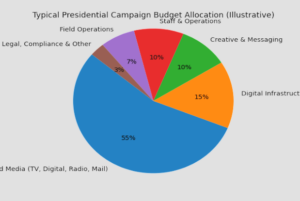
Modern campaigns allocate the majority of their budgets to communication and persuasion. According to data from the Federal Election Commission, the Wesleyan Media Project, the Brennan Center for Justice, and Pew Research, most campaign spending goes toward paid media, digital infrastructure, creative, and messaging.
This chart illustrates a typical modern presidential campaign budget. Roughly 80% of total spend is marketing-related when you combine paid media, digital platforms, data, and creative. The remaining portion supports operations, field work, and compliance.
How Political Marketing Spend Has Shifted Over Time
Spoiler Alert: as time goes on, Marketing budgets go through the roof – and for obvious reasons, delegating those marketing budgets has gone almost entirely to Digital Marketing
| Election Year | Approx Paid Media Ad $ | Source |
| 1992 | tens of millions (TV era launch) | historical context on broadcast dominance (Scale Marketing) |
| 1996 | ~$113M+ TV advertising | industry reporting on political TV primacy (1996) (Scale Marketing) |
| 2000 | estimated increase | broader trend of rising campaign costs — FEC campaign totals (FEC.gov) |
| 2008 | digital begins; campaign budgets climb | digital adoption trend (industry writing) (Scale Marketing) |
| 2012 | record TV ad volume | Wesleyan Media Project reporting (Wesleyan Media Project – WMP) |
| 2020 | >$1.5B ad spend | Wesleyan Media Project reporting (Wesleyan Media Project – WMP) |
| 2024 | ~$12B+ total, $1.9B+ online ads | eMarketer and Brennan Center estimates (EMARKETER) |
In the 1990s, campaigns were dominated by broadcast television. Digital advertising did not yet exist as a meaningful channel, so budgets were concentrated in TV, direct mail, and phone outreach.
Between 2005 and 2015, the internet first became campaign infrastructure—fundraising, email, organizing—and then a true paid advertising channel. By 2008 and 2012, digital marketing was no longer optional.
From 2015 onward, political campaigns entered the era of targetable media. Social platforms, mobile devices, and data-driven ad systems reshaped how campaigns reached voters. Budgets followed attention.
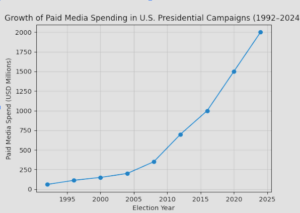
Paid media spending in presidential campaigns has grown from tens of millions in the early 1990s to billions of dollars today. This growth tracks changes in media consumption, not political ideology.
Why This Matters for Businesses
Presidential campaigns do not ask whether marketing works. They assume it does—and spend accordingly. They focus on who they are talking to, what message resonates, where attention lives, and how often that message needs to be delivered.
These are the same principles Syndicate Marketing applies for clients every day. Different budgets. Same playbook.
Got it — tighter, calmer, more confident. Less emotion, more matter-of-fact authority. Here’s a revised outro that reads like a natural close to the blog, not a rebuttal.
Sources & Further Reading
Federal Election Commission – https://www.fec.gov/data/
Wesleyan Media Project – https://mediaproject.wesleyan.edu/
Brennan Center for Justice – https://www.brennancenter.org/
Pew Research Center – https://www.pewresearch.org/