

Keep Your Marketing Dollars Local: Why Local Advertising Matters
There is a fair question behind every local advertising conversation:
“Why should I spend some of my budget locally when I can put it all into Google, Meta, streaming, or another national platform?”
The short answer is: you should not spend locally out of guilt, habit, or nostalgia. Your advertising budget still has to create awareness, leads, visits, calls, reservations, sales, or some other measurable business result.
But local media deserves a place in the conversation—especially for businesses from Lewes to Fenwick—because it can do two jobs at once. It can help a business reach people who are already interested in the Delaware Beaches, while also supporting the people, content, and local infrastructure that make this place easier to discover.
That does not make local advertising automatically better. It makes it worth evaluating on more than one dimension.
Local ownership is a benefit—not a substitute for ROI
Let’s be clear: this is not an anti-Google or anti-Meta argument.
Google Search can be one of the best ways to capture high-intent demand. A person searching “seafood restaurant near Rehoboth,” “Lewes roof repair,” or “where to stay near the beach” is actively looking for an answer. Paid social can be excellent for visual storytelling, retargeting, special events, offers, and staying in front of people who may not be searching yet. Print, direct mail, radio, sponsorships, email, and streaming all have moments when they make sense, too.
A smart marketing plan at the beach is usually a mix.
The case for Delaware Beaches advertising is not that it should replace every other channel. It is that a portion of the budget can work alongside search, social, print, direct mail, and other tactics—while reaching an audience that is specifically connected to this area.
And just as importantly, that local spend still needs to earn its place.
If a campaign is not producing the right kind of attention, traffic, leads, or business conversations, it should be adjusted. Local ownership is an additional benefit. It is not a reason to ignore performance.
A local media buy supports more than an impression
When a business advertises with a local media company, the value is not limited to a banner ad, a sponsored article, a social post, or a directory listing.
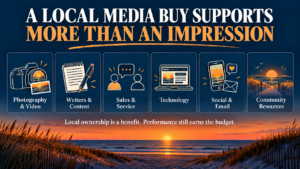
Depending on the package and campaign, that investment can help support local photography, video, writers, content production, sales and customer service, technology, newsletters, social distribution, websites, apps, and community-facing resources.
That matters because local content does not appear by accident.
Someone has to photograph the restaurant when the dining room looks right. Someone has to write the guide to rainy-day activities, update the event calendar, edit the video, publish the special, answer the advertiser, maintain the website, and make sure the information is useful when a visitor is deciding what to do next.
There is an important line to keep straight: no advertiser should assume that a specific percentage of a Delaware Beaches Online payment stays in Delaware. That would require audited information and would vary by business, vendor, staffing, technology, and campaign.
The more accurate point is simpler: a locally operated media company has a local footprint. Its work can involve local people, local knowledge, local businesses, and local content that serves the community and its visitors.
The Delaware Beaches are not one market
This is where local knowledge becomes practical—not just sentimental.
A business in downtown Lewes is operating in a different rhythm than a business on Coastal Highway. Rehoboth has different foot traffic patterns than Bethany. Dewey behaves differently in July than it does in November. Fenwick can be influenced by Ocean City visitors. Route 1 businesses have to think about drivers, residents, vacation-home owners, weekend traffic, and people who are only in town for a few days.
The audience is also not one thing.
The 2024 Southern Delaware Tourism Visitor Survey found that only 20% of surveyed visitors were day-trippers. The rest were staying for a weekend, three days, four to six days, or seven days or more. That creates many decision points: where to eat tonight, what to do if it rains, which event is worth the drive, where to shop, which contractor to call, or where to return on the next trip.
A local media company can build content around those real decisions. It can understand why a brewery event, a restaurant happy hour, a home-services promotion, and a holiday shopping guide should not all be marketed the same way.
That is the value of advertising at the Delaware Beaches: it is not simply buying a placement. It is the ability to participate in a local content ecosystem built around the way people actually use the area.
Local businesses make up a large part of the economic picture
Sussex County is not short on people building businesses. The U.S. Census Bureau reports 6,411 employer establishments in Sussex County in 2023, along with 24,311 nonemployer establishments in 2024. The county’s estimated population reached 277,140 in 2025, up 16.8% from the 2020 Census base. Those Census figures help explain why the local business conversation matters here: there are thousands of owners, operators, independent professionals, and service providers all trying to stay visible in a growing and increasingly competitive market.
Research from other communities has often found that locally owned businesses recirculate more of their spending through local labor, suppliers, professional services, and charitable support than national chains do. Civic Economics has documented that pattern in multiple community studies. Its local-business impact research is useful context—but it is not a Delaware Beaches audit, and it should not be used to claim a specific local-retention percentage for any individual advertiser or media company.
That distinction matters.
The right takeaway is not, “Every local dollar stays local.”
The right takeaway is, “When a locally operated business earns your business, there may be benefits beyond the immediate transaction—provided the work is still effective.”
The year-round beach economy changes the marketing job
The Delaware Beaches are more year-round than they were a generation ago. There are more full-time residents, remote workers, retirees, second homeowners, restaurants open beyond summer, contractors working every month, events on the calendar, and reasons to visit outside peak season.
But “more year-round” does not mean “equally busy all year.”
The shoulder and hump months are often when marketing matters most. Payroll, rent, utilities, insurance, inventory, and overhead do not disappear just because the beach traffic softens. For many businesses, organic discovery is easiest during the biggest summer weeks and hardest when the parking lots are not full.
That is when local content can be especially useful.
A restaurant may need to remind residents about a weekday special. A retailer may need a holiday-shopping angle. A service company may need to stay visible to second homeowners who are planning work before the season. An attraction may need to give families a reason to make the drive on a gray Saturday. A business may need more than a single paid post; it may need a coordinated article, newsletter mention, social content, photography, website placement, and app visibility.
That kind of integrated work is part of what local marketing at the Delaware Beaches can add to a broader campaign.
How to make a local-media investment accountable
The strongest local advertising partnerships are clear about goals before the campaign begins.
Before committing budget, ask questions like these:
- Who are we trying to reach: residents, visitors, second homeowners, or a mix?
- Is the priority awareness, website traffic, leads, reservations, calls, or in-store visits?
- What is the campaign’s time frame?
- What content is included—photography, video, an article, social posts, newsletter placement, web placement, app placement, or creative development?
- How will the campaign be measured?
- What will we change if the first version is not working?
This is where local media should be held to the same standard as every other channel.
A Google campaign should be judged by relevant search visibility, clicks, calls, leads, and cost per acquisition. A Meta campaign should be judged by the right audience, frequency, creative performance, and downstream action—not just likes. A direct-mail campaign should have a clear offer or tracking method. A local media campaign should have agreed expectations around reach, content, engagement, referral traffic, audience fit, and the business result it is meant to support.
The good news is that these channels do not have to compete with each other.
A business can run Google Search for high-intent demand, use social to tell a visual story, invest in print or direct mail for physical presence, and use Delaware Beaches Online to build local relevance and recurring visibility. The same offer can appear in a local article, a newsletter, a social post, a website listing, and a paid-search landing page—each doing a different part of the job.
Keep the local benefit in perspective
There is nothing wrong with using the large platforms. They are part of modern marketing, and many businesses need them.
But it is also reasonable to ask whether some share of the budget can help fund the local photography, storytelling, information, technology, and audience development that make the Delaware Beaches easier to explore and easier to do business in.
That local benefit should never be used to excuse weak results.
It should be considered what it is: a meaningful advantage when the advertising itself is well planned, well executed, and accountable.
For a Delaware beach business, the best marketing mix is rarely all one thing. It is a set of channels working together—some built for immediate demand, some built for long-term recognition, and some built around the local audience that is already here, returning soon, or deciding where to go next.