
Digital vs. Print Advertising at the Delaware Beaches
The question is not whether print or digital is “better.”
The better question is: What job does each channel need to do for your business?
At the Delaware Beaches, that matters because customers do not all behave the same way. Some are planning a summer trip months in advance. Some are searching for dinner while parked near the boardwalk. Some are second homeowners looking for a dependable local contractor. Some are permanent residents deciding where to shop, eat, or spend a Friday night in January.
Print and digital can both be valuable. They simply work differently.
Print gives a business a physical presence. Search captures active intent. Social creates visual repetition and storytelling. Email creates direct recurring access. Direct mail puts something tangible in the home. Local digital media can bring content, distribution, and timely local relevance together.
The strongest campaigns often do not choose one. They make the channels reinforce the same message.
Print is not dead. It just has a different job.
A good print placement can still do things that a digital impression cannot.
It can sit on a coffee table in a rental home. It can be picked up at a hotel front desk, visitor center, restaurant, or local business. It can be seen by someone who is not currently scrolling, searching, or ready to click. It can make a business feel established, local, and worth remembering.
At the Delaware Beaches, print can have real longevity. A visitor guide, lifestyle magazine, local paper, event program, rack card, menu placement, or direct-mail piece may be seen more than once and shared among family members or guests. For businesses with strong visuals—restaurants, shops, attractions, real estate, lodging, home services, and events—that physical presence can be useful.
Print is especially good at:
- Building credibility and local recognition
- Reaching people geographically
- Supporting a seasonal campaign
- Giving visitors something to save, carry, or revisit
- Reinforcing a message they have already seen online
- Staying visible after the first moment of attention has passed
But print does not replace everything else. A magazine ad cannot answer a customer searching “Rehoboth happy hour tonight.” A visitor guide does not replace a current Google Business Profile. A rack card does not update itself when an event changes because of weather.
That is where digital adds something different.
Search and PPC capture active intent
Search is one of the clearest examples of digital doing a job print cannot do alone.
Someone searching “Lewes plumber,” “restaurants near Rehoboth Beach,” “vacation rental management,” “rainy-day activities,” or “best seafood near me” is not just browsing. They are actively trying to solve a problem or make a decision.
Google’s small-business guidance distinguishes between Google Ads’ broader pay-per-click reach and Local Services Ads’ focus on local leads, while noting that the two can complement each other when a business has clear goals and measurement in place. Google Ads and Local Services Ads can serve different purposes in the same small-business marketing plan.
For a Delaware beach business, search and PPC work best when the basics are in place:
- Accurate Google Business Profile information
- Clear hours, services, menu details, and contact information
- Landing pages that answer the searcher’s question
- Tight geographic targeting
- Conversion tracking for calls, bookings, directions, reservations, or leads
- Ads that match the season and the actual customer need
A business does not need to bid on every possible keyword. It needs to show up for the searches that matter most.
A contractor may care about “second home repair Lewes” or “Rehoboth HVAC service.” A restaurant may care about “dinner near Dewey Beach” or “happy hour Rehoboth.” A family attraction may care about “things to do at the Delaware Beaches when it rains.”
Search captures demand when it is already there. Print and social can help create awareness before that search happens.
Social creates repetition, relevance, and a reason to care
Social media is where local businesses can show personality, movement, food, atmosphere, events, staff, customers, seasonal changes, and the real reasons someone should come in.
A strong Reel is not just an ad. It can show the patio on a perfect September evening, a new menu item, the view from a boat tour, a behind-the-scenes look at a local shop, a band setting up for the night, or a fall weekend that reminds people the beach is still active after Labor Day.
Social is especially useful for:
- Visual storytelling
- New-product or menu launches
- Event promotion
- Retargeting people who already know the business
- Reaching people before they arrive
- Staying familiar with past customers
- Giving content a second, third, and fourth life
The key is repetition with a purpose.
A restaurant’s social post may help someone decide where to go tonight. A home-service company’s before-and-after video may build confidence with a second homeowner. A retailer’s Reel may get saved by a visitor planning a weekend in Rehoboth or Lewes.
But a beautiful post is not automatically a complete campaign. It works better when the same message appears somewhere else, too.
Email gives you recurring access
Email is easy to underestimate because it is not as visible as a Reel or as immediate as paid search. But for businesses that have earned permission to stay in touch, it is one of the few channels that creates direct recurring access to an audience.
That can be valuable for:
- Restaurant specials and events
- Seasonal openings and closings
- Holiday promotions
- Fall and winter offers
- New products or services
- Repeat-visit reminders
- Second-home maintenance tips
- Local event roundups
- Loyalty and customer retention
The difference is that email should give people a reason to keep opening it.
A weak email says, “Here is our business again.” A useful email says, “Here is what is happening this weekend,” “Here is a local special worth knowing about,” “Here is what changed for the season,” or “Here is something you may want to book before you come down.”
For Delaware beach businesses, that ongoing relationship can matter most in the shoulder months, when the summer traffic is gone but payroll, rent, insurance, inventory, and overhead have not disappeared.
Local digital media brings content and distribution together
Local digital media is not the same thing as generic display advertising.
It can combine timely content, local relevance, distribution, searchable pages, social sharing, newsletters, and app visibility in a way that helps a business become part of what people are already looking for at the beach.
That might mean appearing alongside a local event story, reaching visitors through an article or Reel, being included in a newsletter, showing up in a guide, or helping someone discover a business while they are deciding what to do nearby.
That is one reason Delaware Beaches advertising can work well as part of a larger marketing mix. It does not need to replace Google, Meta, print, direct mail, or email. It can help connect the message across the channels people use before, during, and after a beach visit.
A local business has more to gain when the content, photography, social distribution, email, web visibility, app visibility, and creative direction support one another instead of operating as separate, unrelated tasks.
Direct mail still works best when it works with digital
Direct mail has something digital does not: it arrives in a physical place.
For a local restaurant, contractor, retailer, real estate business, health provider, or service company, a well-targeted mail piece can reach nearby households, new residents, specific neighborhoods, or second homeowners in a way that is hard to ignore.
But the strongest direct-mail campaigns do not stop at the mailbox.
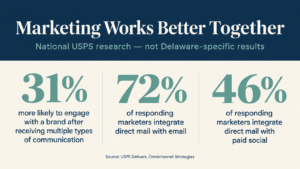
According to USPS Delivers’ national omnichannel marketing research, 31% of people are more likely to engage with a brand when they receive multiple types of communication. The same research reports that 72% of responding marketers integrate direct mail with email, and 46% integrate direct mail with paid social.
Those are national USPS research figures, not Delaware-specific results. Still, the takeaway is useful locally: a campaign is usually stronger when one message appears in more than one relevant place.
National USPS research figures, not Delaware-specific results. Source: USPS Delivers, “Omnichannel Strategies.”
A direct-mail piece can point to a landing page. A QR code can make it easy to book, browse, or claim an offer. Paid social can reinforce the same message after the mail arrives. An email can remind past customers that the offer is active. Search can catch the person who looks up the business after seeing the mail piece.
That does not mean every campaign needs every channel. It means the channels should work together when they are used.
Five practical combinations for Delaware beach businesses
1. Print + landing page
A print ad, guide placement, magazine campaign, or rack card can create awareness and credibility. A simple landing page gives the reader somewhere specific to go next.
For example, a restaurant running a print campaign around spring reopening could send readers to a page with the current menu, reservations, outdoor seating details, and an email signup. A contractor could send readers to a seasonal home-maintenance checklist and a request-a-quote form.
The print piece gets attention. The landing page makes that attention measurable and useful.
2. Direct mail + retargeting
A neighborhood mail campaign is more useful when people see a familiar message again online.
A home-service company might mail nearby homeowners about fall HVAC service, winterization, landscaping, pest control, or a second-home checkup. Retargeting can then reinforce the same message to people who visited the campaign page or engaged with related content.
The mail piece makes the introduction tangible. Digital gives the campaign follow-up and frequency.
3. Google Search + local content
Google Search works well when someone already has a question. Local content helps a business show up before the question becomes urgent.
A restaurant could use search ads for immediate dining intent while supporting them with local articles, event coverage, menu features, social content, and timely visibility through advertising at the Delaware Beaches. A home-service company could run high-intent search campaigns while publishing helpful local service pages that build trust over time.
Search catches demand. Content helps create familiarity.
4. A local Reel + newsletter + article
A single strong local video can do more than live on social for 24 hours.
A Reel about a new restaurant menu, event, attraction, shop, seasonal offer, or beach experience can become part of an article, a newsletter feature, a local guide, and an app or website placement. The message stays consistent, but each format meets the audience differently.
Someone may see the Reel while scrolling. Someone else may open the newsletter the next morning. Someone else may find the article in Google two weeks later.
That is not duplicate marketing. It is coordinated marketing.
5. Magazine campaign + social reinforcement
A magazine or print-guide campaign can build a polished, long-life presence. Social can keep that campaign current.
If the print creative highlights a summer menu, fall getaway, home-service specialty, new location, or seasonal event, social can provide updates, behind-the-scenes content, reminders, and real-time reasons to act.
The print piece says, “We are established.” The social campaign says, “We are active right now.”
The Delaware Beaches are increasingly year-round
The old idea that the coast simply goes quiet after Labor Day is less true every year.
There are more fall events, more remote workers, more second-home activity, more weekend visitors, and more reasons for people to come down outside the traditional summer window. But every business owner knows a February weekday does not feel like a July Saturday.
That is exactly why a multi-channel approach can matter most in the shoulder months.
Organic traffic softens. The business still has payroll and overhead. Customers need a reason to visit, book, buy, or remember the business now—not just next summer.
A well-timed mix might include a direct-mail offer for local households, search campaigns for high-intent service needs, a social push around an event, a newsletter to past customers, a magazine placement for planning visibility, and local digital content that keeps the business in the conversation.
The right mix will be different for every business. A restaurant, contractor, boutique, attraction, medical provider, real estate company, and vacation-rental manager all have different customer journeys.
That is why local marketing at the Delaware Beaches should be built around the business, the season, and the audience—not around the idea that one channel has to do everything.
The bottom line
Print is not dead. Digital is not a magic shortcut. Direct mail is not old-fashioned when it is targeted and connected to a useful next step. Social is not enough without a reason to act. Search is powerful, but only when a business is ready to answer the customer who finds it.
The most effective Delaware beach marketing campaigns make the channels reinforce one another.
Give people something physical to remember. Make it easy to search when intent is high. Stay visible on social. Use email to keep the relationship going. Connect local content, print, direct mail, and digital around one message that matters.
That is how a campaign lasts longer than one impression—and how a local business stays visible before, during, and after a customer’s beach visit.