
How to Reach Tourists & Second Homeowners at the Delaware Beaches
There is no single “Delaware beach visitor.”
A restaurant in Rehoboth may be trying to get a same-day dinner decision from a family already parked near the boardwalk. A Lewes retailer may be trying to get on a weekend visitor’s saved list before the drive down. A Bethany-area home-service business may care far more about the second homeowner who comes down every few weeks than the person who visits once in August.
Those are different audiences, at different moments, using different channels.
That is why a business cannot build a real beach marketing plan around one assumption: that every visitor is a day-tripper, every tourist arrives with a plan, or every customer is local. The Delaware Beaches have permanent residents, day visitors, weekenders, multi-day vacationers, repeat guests, and people who own a place here but are not here every week. The most useful marketing is the kind that understands where someone is in that cycle.
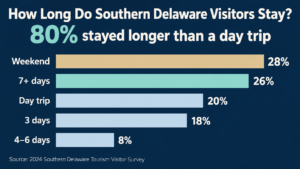
The 2024 Southern Delaware Tourism Visitor Survey makes the point clearly. Only 20% of respondents reported taking a day trip. The other 80% were staying for a weekend, three days, four to six days, or seven days or more.
That is a lot of time for a visitor to decide where to eat, where to shop, what to do if it rains, which event to attend, whether to book another activity, and which local business they will remember next time.
Southern Delaware visitors are not just passing through
The survey found that:
- 28% of visitors took a weekend trip.
- 26% stayed seven or more days.
- 20% were day-trippers.
- 18% stayed three days.
- 8% stayed four to six days.
In other words, weekenders and weeklong visitors make up more than half of the respondents. That matters because someone staying several nights behaves differently from someone who came down for lunch and a walk on the boardwalk.
Source: 2024 Southern Delaware Tourism Visitor Survey. The chart’s key takeaway is that 80% of respondents stayed longer than a day trip.
A day-tripper may make one quick decision about parking, lunch, ice cream, or shopping. A family in town for five nights has many more decision windows: breakfast, beach supplies, dinner, rainy-day plans, a brewery stop, a bike rental, an evening event, and the “what are we doing tomorrow?” conversation that happens after everyone gets back to the rental.
The same survey shows why lodging context matters, too. Hotels and motels accounted for 43% of reported accommodations, while Airbnb represented 17% and short-term rentals 13%. Each setting creates a slightly different marketing opportunity. A guest in a hotel might be looking for something close by that night. A family in a rental may be planning a week of meals, beach days, and activities. Both are visitors, but they are not at the same stage of the trip.
There is also a smaller but important owned-vacation-property audience in the survey. These are people with a longer relationship to the coast. They may not need a generic “Welcome to the beach” message. They may need a trusted restaurant for friends visiting, a dependable HVAC company, a contractor, a favorite happy hour, a reason to come down in November, or a reminder that there is still something happening after Labor Day.
That is the difference between advertising to a crowd and building visibility with an audience.
Opportunity one: reach people before the trip
A lot of beach decisions are made before the car ever reaches Route 1.
People research where to stay, where to eat, what to do with kids, where to find live music, whether an attraction is open, which beach works best for their group, and what to do when the weather does not cooperate. They search Google. They browse maps. They scroll social media. They ask friends. They save restaurant reels and event posts. They sign up for emails. They look at the places that appear to understand the area.
For local businesses, this is where useful web and search content matter.
A restaurant should be easy to find for the questions people actually ask: “best seafood in Rehoboth,” “restaurants near the boardwalk,” “Lewes dinner with outdoor seating,” “happy hour near me,” or “family-friendly food at the beach.” A rental business should answer planning questions before someone books elsewhere. A shop should show what makes it worth adding to a visitor’s list. An attraction should make its hours, location, tickets, parking, and weather plan simple to find.
That does not mean every business needs to become a media company. It means the basics should be present and current:
- A fast, accurate website with the right local information
- Search-friendly pages that answer real customer questions
- Current menus, hours, services, pricing, and availability
- Strong original photography
- Social content people can save and share
- Email or newsletter reminders that are actually useful
- A clear path from curiosity to booking, calling, visiting, or ordering
This is where Delaware Beaches advertising can complement search, social, paid campaigns, print, and direct outreach. Local discovery media helps put businesses in front of people who are already researching the coast, but it works best when the business has something helpful and current to send them to.
The point is not to abandon Google, Meta, direct mail, or print. Each can play a role. The point is to make sure the message fits the stage of the trip.
A family planning a July vacation may respond to a polished guide, a saved social post, a search result, or an email about events during their stay. A second homeowner deciding whether to come down for a fall weekend may respond to a newsletter, an event calendar, a familiar local brand, or a social post that makes the beach feel active in the off-season.
Opportunity two: win the decisions that happen during the trip
Once visitors arrive, marketing becomes more immediate.
They are no longer asking, “Should we go to the Delaware Beaches?” They are asking, “Where should we eat tonight?” “What can we do with the kids if it rains?” “Is there live music?” “Where can we park?” “What is open near us?” “Where can we get breakfast before the beach?” “What should we do in Lewes this afternoon?”
Those are in-market decisions. They are often fast, mobile, and location-driven.
The Southern Delaware visitor survey lists going to the beach, dining out, tax-free shopping, visiting breweries and wineries, antiquing, museums and historic sites, special events and festivals, cultural arts, biking, and fishing among the leading visitor activities. That is not one audience. It is a daily series of choices spread across the coast.
For a business, the in-market question is simple: are you easy to find at the moment you are useful?
A good answer can include:
- A clear Google Business Profile with current hours, photos, and reviews
- Search content for high-intent local queries
- Social posts that communicate today’s special, tonight’s event, or a timely offer
- Email that helps repeat visitors decide what to do this week
- Website pages that load quickly on a phone
- Accurate map, parking, and contact information
- Listings, calendars, and location-based content that people see while they are here
This is also where the DBO app and local digital channels can be especially useful. When someone is already at the beach, timely information has a different value. Restaurant specials, happy hours, events, weather-sensitive activities, live cameras, beach access, and rainy-day options are not just content—they can answer the question someone is trying to solve right now.
That is why an in-market message should be specific. “Come visit us” is vague. “Live music Thursday at 7,” “family dinner before the Bandstand,” “rainy-day activity open today,” “happy hour until 6,” or “reserve your kayak for this afternoon” gives someone a reason to act.
A business that only advertises its name can be remembered. A business that solves a real beach-day decision is more likely to get the visit.
Opportunity three: stay visible after the trip
The coast has a powerful repeat-visit economy.
People do not just leave Southern Delaware and forget it. They come back for another weekend, return for the holidays, book the same rental next summer, bring different friends, visit their second home, or make the drive down when the weather breaks in spring or fall.
That is why the post-trip stage is so valuable.
A visitor who had a good experience can become a repeat customer, a social follower, an email subscriber, a reviewer, or someone who recommends the business to the next group coming down. The best time to start building that relationship is not the next Memorial Day weekend. It is while the visit is still fresh.
For businesses, that means creating a light but consistent follow-up system:
- Ask for the email signup while the customer is engaged
- Keep social channels active after summer, not just during it
- Share fall events, holiday openings, spring specials, and off-season reasons to return
- Use newsletters to be useful, not just promotional
- Give repeat visitors a reason to feel like insiders
- Keep content updated for the questions people ask before their next trip
Second homeowners deserve particular attention here. They are not exactly tourists and not always full-time locals. They may be in town frequently, own a home that needs service, host visiting friends and family, and make decisions throughout the year. They notice whether a business stays dependable outside peak season.
That is why advertising at the Delaware Beaches should be treated as part of a full marketing mix, not as a summer-only line item. Google search, paid social, local media, email, direct mail, partnerships, and digital visitor platforms can all support different moments in the customer relationship.
Do not forget the year-round local audience
Tourism is central to the Delaware Beaches, but local residents matter all year.
Sussex County’s estimated population reached 277,140 in 2025, up 16.8% from the 2020 Census base, according to the U.S. Census Bureau’s QuickFacts for Sussex County. The county also has more than 164,000 housing units and more than 106,000 households. Those figures are not a count of second homes, but they are a useful reminder that the local market is larger and more layered than a summer-weekend snapshot.
Residents, new arrivals, retirees, remote workers, parents, service workers, and business owners are here when the peak crowds are gone. They need restaurants, health care, contractors, home services, retailers, events, and things to do. A marketing plan that serves only July visitors can miss a meaningful part of the customer base.
This is one reason the shoulder months matter so much. The beach is increasingly year-round, but the natural volume of walk-in traffic still drops. Payroll, rent, insurance, inventory, and operating costs do not. The businesses that stay visible in fall, winter, and spring are not necessarily shouting louder; they are often simply showing up with a more useful reason to choose them.
Build the message around the moment
The practical lesson is not that every business needs every channel.
A restaurant may need strong social content, search visibility, happy-hour listings, and email reminders. A home-service company may need local SEO, Google Ads, direct mail, and recurring visibility with second homeowners. A retailer may benefit from visitor guides, in-market discovery, event tie-ins, and content that turns a one-time vacation stop into a repeat destination. A family attraction may need planning content before the trip, weather-sensitive updates during the trip, and a list-building strategy afterward.
The best approach is to match the message to the moment:
| Customer moment | What they are thinking | Useful marketing tools |
|---|---|---|
| Before the trip | Where should we stay, eat, shop, and spend our time? | Search content, website guides, social, visitor media, newsletters, paid search |
| During the trip | What should we do right now? | Google Business Profile, maps, social, event calendars, app visibility, timely offers |
| After the trip | Will we come back, recommend it, or use this business again? | Email, social, reviews, off-season content, repeat-visit campaigns |
The businesses that understand these moments are easier to find before the trip, more useful during the trip, and more memorable after it.
That is the opportunity with local marketing at the Delaware Beaches: not to treat every customer like the same visitor, but to meet the right person with the right message when it has a real chance to matter.
The bottom line
The Delaware Beaches are not one audience and not one season.
Some customers are here for a few hours. Some are here for the weekend. Some are here for a week. Some come back every year. Some own a home here and make decisions all year long. The businesses that reach them most effectively are the ones that think beyond a single placement or a single busy Saturday.
Be visible before people arrive. Be useful while they are here. Stay familiar after they leave.
That is how a beach business turns one visit into a customer relationship.